
The word itself is barely older than a hundred years. In October 1916, a Unitarian minister and essayist named Samuel Crothers, also a committed opponent of slavery and racial discrimination in his public life, published a piece in the Atlantic Monthly called "A Literary Clinic." In it, a librarian character named Bagster runs a private practice of prescribing books the way a doctor prescribes medicine: a book, he explains, can act as a stimulant, a sedative, an irritant, or a soporific, and the point is that it does something to you, so you ought to know what. Crothers welded the Greek biblion, book, to therapeia, healing, and gave the practice a name that stuck: bibliotherapy. The idea caught on quickly among people who took it seriously. Eleanor Roosevelt praised the practice, and in 1966 the Association of Hospital and Institution Libraries formally recognized the term. But the thing Crothers named was already ancient. He was simply the first to put a label on something libraries, and writers, had been quietly claiming to do for two thousand years.
Ancient philosophers were already arguing that literature, spoken first and later written, could heal what they called the diseases of the soul, easing the passions that moved through a person whether they liked it or not. Aristotle built an entire theory around it: catharsis, the idea that tragedy lets an audience purge emotion rather than simply feel it. Cicero, in his letters known as Cura ut valeas, praised the therapeutic power of written correspondence itself. The orator Aelius Aristides went further still in his Hieroi Logoi, describing what he called literary remedies outright.
The library at Thebes in ancient Greece reportedly carried an inscription over its entrance: "The Healing Place of the Soul." The great library of Alexandria, founded around 300 BC, is said to have borne a similar promise, medicine for the mind. Centuries later, the medieval Abbey Library of Saint Gall in Switzerland described itself, in an inscription still legible today, as a "Medicine Chest for the Soul." The conviction never really went away. Montaigne wrote about it in the sixteenth century. Victor Hugo, in the nineteenth, put it in a line that has outlived most of what else he wrote that day: to read is to eat and drink, and a mind that does not read grows thin the way a body that does not eat grows thin. Marcel Proust, in an essay on reading published at the turn of the twentieth century, went as far as calling reading a curative discipline for what he termed spiritual depression, and compared what a book does for a struggling mind to what a psychotherapist does for certain patients.
The practice became more deliberate as it moved from metaphor to method. By the late eighteenth century, hospitals in France, England, and Italy were using structured reading in the treatment of mental illness; by 1900, libraries were standard in nearly every European mental hospital. American physicians caught up more slowly. Benjamin Rush, one of the signers of the Declaration of Independence and a pioneering figure in American psychiatry, began prescribing scripture and other reading to his patients in the early 1800s. By the twentieth century, hospital libraries in the United States had become, in one historian's phrase, "intellectual and emotional pharmacies."
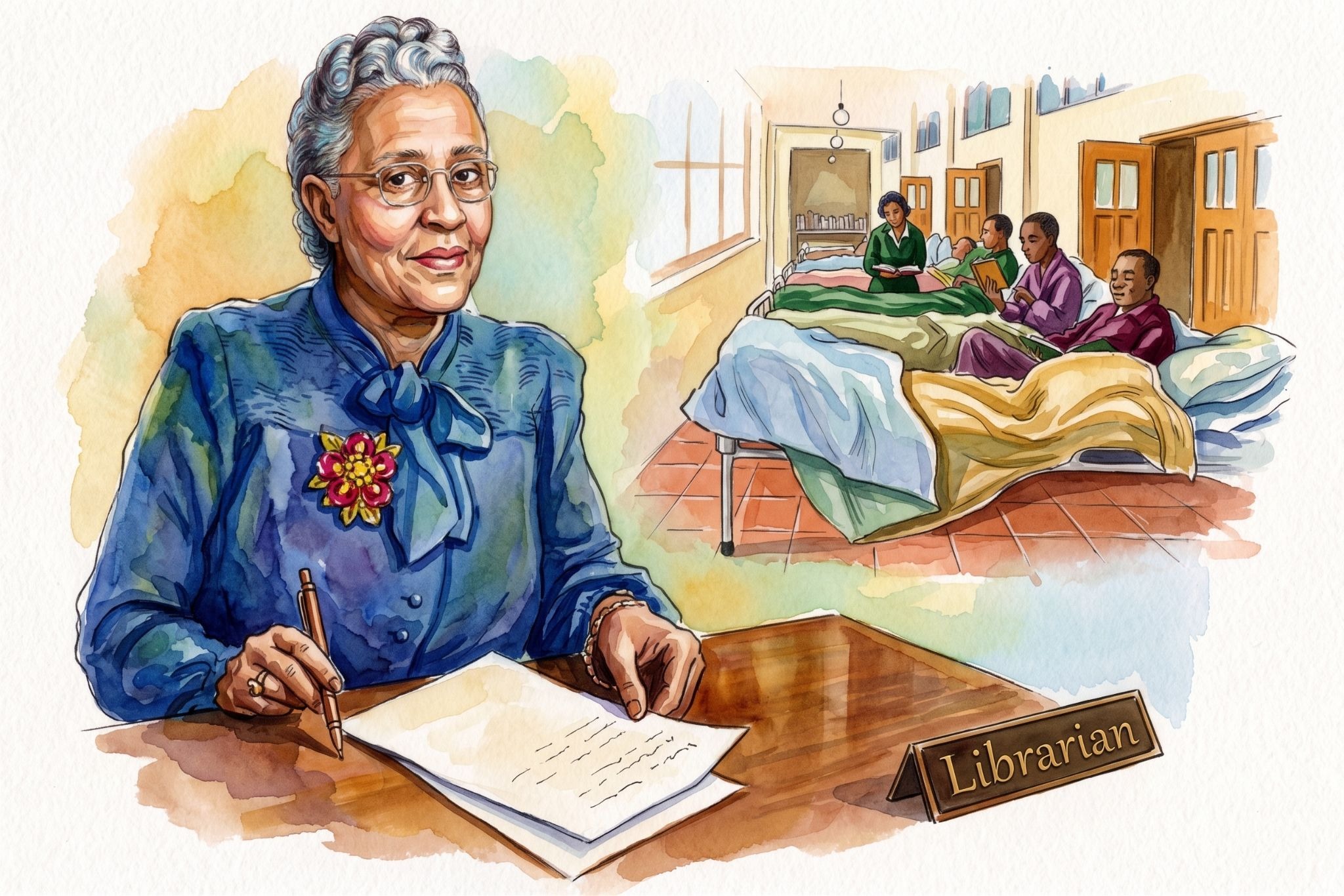
No one did more to turn that phrase into a working method than Sadie Peterson Delaney. Born in New York State in 1889, she started out as a poet and a women's-rights organizer before training as a librarian in 1921. She first built reading programs at the library in Harlem, working to bring books to blind readers and to young people the system had written off as delinquent. In 1924 she took a post at the Veterans' Hospital in Tuskegee, Alabama, where the library amounted to two hundred books and a single table. She built it into a real practice: choosing reading for each patient according to their specific difficulties, using stories and read-aloud sessions to help veterans reconnect emotionally after the traumas of combat, that same tailoring to the individual reader is still one of the foundations of the field today. She rigged book carts that could travel between wards, arranged projected readings for patients too injured to hold a book, and taught braille to those who had lost their sight. Within a year the collection had grown from two hundred books to four thousand, and she was encouraging patients to take part in book fairs, speak in public, and go on the radio. She was named Woman of the Year three years running, 1948 through 1950, by civil rights organizations, received an honorary doctorate from Atlanta University, and in 1934 was invited to lecture in Rome. Librarians and students crossed the Atlantic to study her methods, and her influence reached France through Lucie Guillet, who after the Second World War began encouraging patients with mental illness to read poetry.
For most of its history, bibliotherapy was described in terms of what it accomplished rather than how. That changed in 1949, when Caroline Shrodes completed a doctoral dissertation at Berkeley that is still cited as the field's founding piece of theory. Shrodes proposed that a successful encounter between a reader and a book moves through three stages.
First comes identification: the reader recognizes something of their own life in a character or situation, and the recognition arrives less as an idea than as a jolt, what Shrodes called a shock of recognition. Then comes catharsis: because the character's trouble is not literally the reader's own, the reader can afford to feel it fully, releasing emotion that might otherwise stay locked down. Shrodes described this as the peculiar freedom of being "both spectator and participant" at once. Finally comes insight, not necessarily a solution, but a reorganizing of the problem into something the reader can actually think about, rather than simply endure. A teenager who identifies with Kunta Kinte in Roots doesn't come away with a plan; he comes away thinking, as one such reader once put it, "if he could stay strong and proud, so can I."
Contemporary practitioners tend to fold this down into two working parts rather than three. Céline Mas, co-founder of the French bibliotherapy company Love for Livres, describes it in her book La lecture pour réussir sa vie professionnelle as a double movement: identification, where the reader meets a character's situation with their own empathy, and interaction, where the reading experience is shared inside a community of readers who help each other hold what came up. Either way, the choice of book, the timing, the conversation around it, all of it exists to make that recognition, that release, and that reordering more likely to happen.
Ask a psychiatrist and a children's librarian to define bibliotherapy and you may get two different answers, because the word has always stretched across a wide continuum. Practitioners in the field now generally sort it into four registers, which are often blended depending on what a given situation calls for.
Clinical bibliotherapy is carried out by trained mental health professionals treating significant emotional or behavioral difficulties. Developmental bibliotherapy is gentler and more preventive, used by teachers and other non-specialists to support the ordinary growth of people who are, on the whole, already well: a teacher handing a child a picture book about a new sibling before the baby arrives, say, rather than treating any diagnosis. Creative bibliotherapy usually happens in a group, built around carefully chosen works of fiction that lead into discussion and creative exercises such as drawing or writing. And prescriptive bibliotherapy is the most clinical-sounding of the four: self-help books used, in a therapeutic setting or at home, to help shift patterns of thought, feeling, or behavior. Surveys of American clinicians in the 1980s found that a striking majority of psychologists and medical doctors used some form of bibliotherapy, and nonfiction, structured self-help material tends to have the strongest evidence base in this register, precisely because it is the easiest to study.
The last two decades have added something looser still, more literary than clinical, popularized by writers like Ella Berthoud and Susan Elderkin, whose 2013 book The Novel Cure offered novels, not self-help, as remedies for hundreds of life's ordinary and extraordinary ailments, from heartbreak to boredom to grief. This register leans on the specific power of fiction: not information about a problem, but the experience of inhabiting someone else's mind while carrying it. It is what many readers are doing when they reach for a novel in a hard season. They aren't managing a diagnosis. They are looking for company.
Bibliotherapy has had its skeptics, and reasonably so, it is hard to run a controlled trial on the experience of being moved by a book. But the evidence for structured versions of the practice has grown considerably harder to dismiss. A 2009 study at the University of Sussex found that reading calmed participants' heart rate and muscle tension within minutes, and that as little as six minutes of deep reading could cut stress levels by as much as sixty-eight percent, more than either listening to music or going for a walk. Separately, researchers at the University of Liverpool have found that people who read regularly report greater happiness overall, while non-readers are considerably more likely to develop symptoms of depression.
In the United Kingdom, the Reading Well "Books on Prescription" scheme, run by public libraries since 2013 in partnership with health services, has seen roughly 3.8 million books borrowed through GP and pharmacy referrals, with surveys finding that around nine in ten readers found the book they were given genuinely helpful. As of 2025 the scheme is being piloted directly inside general practice surgeries as part of the UK's broader social-prescribing movement, doctors writing a book alongside, or instead of, a prescription. Researchers at the University of Liverpool's Centre for Research into Reading, Literature and Society have also spent years studying "shared reading" groups, in which a facilitator reads aloud to a small group and pauses to let the conversation go wherever the text takes it, findings that consistently link the practice to measurable gains in wellbeing, particularly for people managing chronic illness, depression, or isolation. The field has started moving into universities in its own right, too: in France, the University of Strasbourg now offers a diploma in Letters, Ethics, and the Arts that includes a full bibliotherapy track, with students designing and running their own reading workshops over a semester. None of this proves that any book will heal any reader. It does suggest that the intuition carved over library doors in Thebes was onto something real.
It's worth being precise about the edges of the term, because bibliotherapy gets diluted the moment it's used as a fancy synonym for "reading is good for you." Reading widely and reading therapeutically are not automatically the same act. Bibliotherapy, in any of its registers, involves some degree of intention: a book chosen for a particular person, at a particular moment, for a particular need, often with someone else, a therapist, a librarian, a teacher, a trained facilitator, thinking carefully about the fit. It is not a replacement for psychotherapy in cases of serious mental illness. No bibliotherapy practitioner worth the name would claim otherwise, and anyone whose situation calls for real therapeutic or medical follow-up needs to hear that plainly. Where it earns its keep is alongside other care, or ahead of it, or in the wide territory of ordinary life that never required a diagnosis in the first place. What makes it real rather than sentimental is exactly that specificity: the right book, for this reader, right now.
James Baldwin, who understood better than most what a book could do for a person nobody else believed, put it this way: "You think your pain and your heartache are unprecedented in the history of the world, but then you read. It was books that taught me that the things that tormented me most were the very things that connected me with all the people who were alive, or had ever been alive." That connection, not information, not advice, but the sudden company of someone who has already survived what you're going through, is what the word has been pointing at since long before it had a name.